
Call us now!
1-215-235-4300

The Tonfa Baton: An Ancient Tool Updated for Modern Times

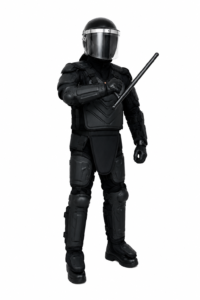
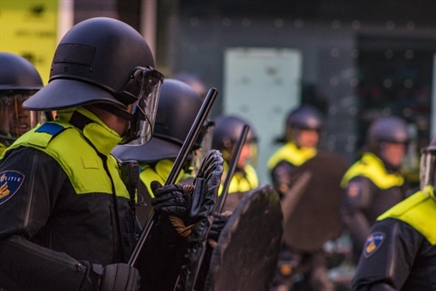
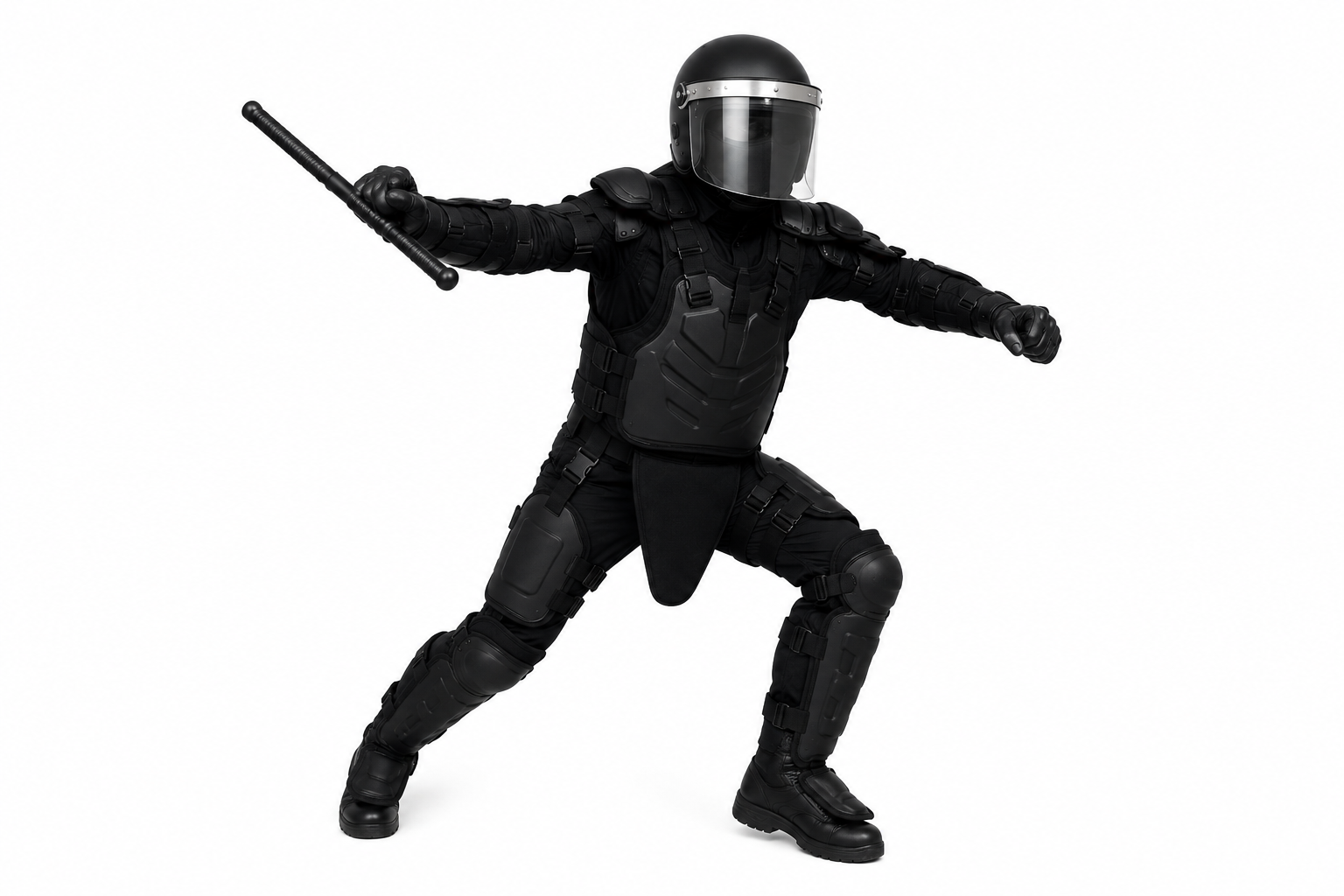
Police impact tools have evolved over time. Back in your grandpa’s day, a police officer “on the beat” likely carried a Billy Club or a Blackjack, with the handle directly in-line with the force-delivering body of the weapon. But since the early 1980s, side-handle batons such as the Tonfa or PR-24 have become one of law enforcement’s non-lethal tools of choice for more sophisticated crowd control and anti-riot operations, and for maintaining public order during national emergencies.

EDI-USA is a leading manufacturer of Tonfa batons, offering increasingly hard-to-source fixed baton models. Our top-of-the-line Tonfa batons come in either polycarbonate or polypropylene material: tough polycarbonate lends durability and impact resistance, while lighter-weight polypropylene enables swifter maneuvering and greater ease of carry.

EDI-USA’s Tonfa Baton comes 23.5 inches (60 cm) long, but custom dimensions are also available to be manufactured upon request. Contact one of our product specialists to discuss what material and size is right for your team’s needs.

The EDI-USA Tonfa baton design is based on a centuries-old defensive weapon, originally made of hardwood, said to have been used by Okinawan farmers and later adapted into Japanese martial arts.

The Tonfa or PR-24’s unique side-handle design makes it much more than just an impact weapon— it is also a pressure-point activator and a joint-locking tool. The side handle can be used either as an impact head for prodding densely muscled pressure points on a combatant, or as a fulcrum point for rapidly spinning the main baton shaft to build momentum and deliver maximum blow force. The side-handle design can also make it more difficult for combatants to grab hold of the baton or steal it from the user.

However, this more sophisticated design requires more extensive training to use properly, for both the user’s and the combatant’s safety. For that reason, Tonfa-style batons are often used by Special Forces units. Perhaps it’s no coincidence that the Okinawan tunfa, which inspired the modern Tonfa police baton, is still used in kobudo martial arts.

Wondering if the Tonfa baton is right for your team? Contact EDI-USA today to get a quote.
Are Non-Lethal Weapons Effective?

Are Non-Lethal Weapons Actually Effective?

Yes! Non-lethal weapons are very effective and a great option for any team that may want to mitigate the risk of accidental deadly force, or increase their department’s tactical skills to include non-lethal response strategies.

In the late 80’s the world’s military and police forces created the Non-Lethality Policy Review Group in an effort to develop weapons that were more life-conserving, environmentally friendly, and fiscally responsible than weapons available at that time. Since then there have been huge advancements in non-lethal technology.

There are actually several countries worldwide that enforce their police members solely with non-lethal weapons:

  • United Kingdom
  • Norway
  • Ireland
  • Iceland
  • New Zealand

Not to our surprise, a 2009 study has shown that monthly incidence of injury declines significantly, by 25% to 62%, after adoption of non-lethal devices. This is a huge incentive for your force and community to support the use of the most popular non-lethal devices.

Most Popular Non-Lethal Weapons

  • Side Handle Baton: A classic non-lethal tool made popular by the police as far back as the 1800’s. The side handle baton is regarded greatly for its effective defensive qualities. The side-handle component prevents the baton from rolling far away if inadvertently dropped, helps to quickly block attacker’s blows, and has the ability to deliver a powerful hit when used with the power stroke technique. See video here.
  • Electric Baton: A modern variation designed to administer an electric shock in order to incapacitate the target. It consists of an insulated handle and guard, and a rigid shaft usually a foot or more in length for delivering a shock. Many designs function like an elongated stun gun or a cattle prod, requiring the tip to be held against the target and then manually triggering a shock by a switch in the handle. Some more sophisticated designs carry a charge along the shaft’s entire surface, administering a shock on contact. This later design is especially useful in preventing the officer from having his weapon grabbed and taken away by an assailant. See video here.
  • Extendible Baton: expandable batons may have a solid tip at the outer end of the innermost shaft; the purpose of the solid tip is to maximize the power of a strike when the baton is used as an impact weapon. Expandable batons are made in both straight and side-handle configurations, but are considerably more common in the straight configuration. The idea being that should violence suddenly escalate the baton can be easily deployed but can be stowed neatly away so as not to affect movement due to its mounting point on the officer’s clothing. See video here.
  • Taser & Stun Gun: The Taser is an electroshock weapon developed in the 1970s. Using compressed nitrogen charges, it fires two hook-like electrodes that send an electrical current into a person, causing involuntary muscle spasms. The weapon can also be used without propelling electrodes, producing instead an electrical arc that can be thrust into a person. Tasers are designed to be used instead of firearms, greatly reducing deaths in the process; fewer injuries to police officers have been achieved with its use as well. See video here.
  • Net Gun: Inspired by Spiderman comics and movies, this shotgun-like device fires a Kevlar net, which, traveling at about 65 mph, wraps up the suspect or criminal in a spider-like fashion, until police can handcuff him or her. See video here.
  • Pepper Spray: causes temporary blindness and difficulty breathing, the effects of which lasting from 30 to 60 minutes. Some pepper spray formulas are combined with tear gas, to cause profuse tearing and disorientation. Some formulas have a dye included in the spray to mark the attacker for possible identification by law enforcement at a later time. See video here.


Many Options! Don’t Hesitate to Ask Up For Help in Deciding

If you would like additional guidance to decide what non-lethal weapons will be best for your team please contact us, we are confident that we can deliver all of your tactical customization needs.

Take a look at our full catalog to see all the gear that we can customize for you and your team.